Bharat Newz 24*7
West Bengal Chief Minister Mamata Banerjee has delivered a stern warning to the BJP after reports that over 4 million voter names were deleted in Bihar. She cautioned that if Bengal attempts the same—deleting voter names or sending citizens to detention camps—the state will respond with mass movements, including comprehensive protests and a new “language movement.” This article outlines her statements, key programs, and the mobilization strategies set in motion.
Voters at Risk: A Repeat of Bihar in Bengal?
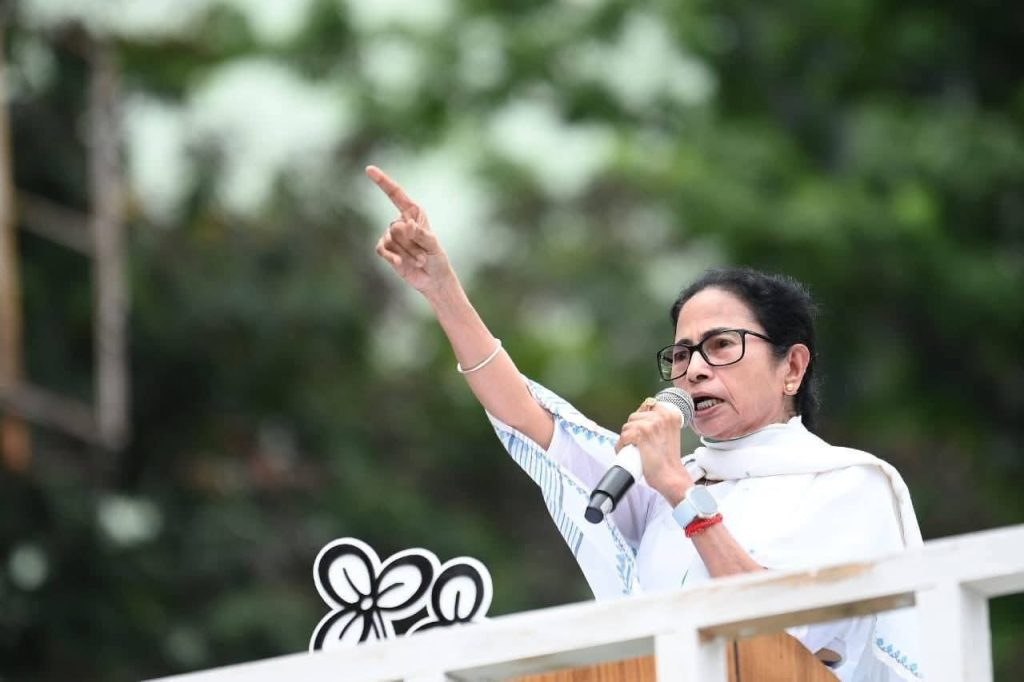
“Over 4 million voter names have been removed in Bihar. Are you planning to do the same in West Bengal? If you try, we will launch sit-ins and intensify protests. We’ll not allow deletion of names or any detention camps,” said the CM in Kolkata on July 21, 2025.
She highlighted a central government notification (dated May 2, 2025) that allows authorities to detain people suspected of being illegal immigrants—for up to one month or more. She added, “Over 1,000 individuals have already been sent to Bangladesh, Rajasthan, UP, Chhattisgarh, MP, and Odisha.” A second circular issued in July reportedly requires appointment of nodal officers to purge voter lists and revoke citizenship rights, especially hitting Bengali speakers. “They’re waging terror on the Bengali language,” she declared.
Launching a Language Movement: Join Us Every Weekend
From July 27 onward, Banerjee announced that the state government would begin a five-pronged weekend protest strategy:
-
Saturday–Sunday marches and rallies against abuses targeting Bangla language.
-
Inclusion of people from diverse linguistic backgrounds.
-
Support for migrant workers and their families—anyone facing difficulties is urged to come forward.
-
A public platform for lodged complaints—citizens can notify TMC about local harassment incidents.
-
A strong public-cultural defence of linguistic diversity, emphasizing solidarity and equality of all languages.
She described it as a “language movement” surpassing even historical struggles, comparing it to the 1993 “No ID, No Vote” protests in Bengal—where 13 people sacrificed their lives to defend democratic voting rights.
The 1993 Movement and Its Lessons
Banerjee reminded audiences of that watershed moment: “From 1993, we have celebrated it as Martyrs’ Day—Mother-Land-People Day, Democracy Rescue Day. Without that movement, there would be no voter cards today. Democracy won at the cost of 13 lives. That fight continues, till we bring change to Delhi and bid farewell to BJP.”
Accusations vs Achievements: Putting Bengal’s Record Forward
CM Banerjee sharply criticized the BJP and select Left factions, accusing them of spreading false propaganda and socially antagonistic narratives. She then proudly listed welfare achievements under her TMC government:
-
Khadyasathi free rations to nearly 90 million beneficiaries
-
Swasthya Sathi universal health coverage
-
A 40% drop in unemployment
-
Creation of 770,000 job cards via the Karmasree scheme generating 830 million man-days of work
-
Distribution of 2.2 million SC/ST/OBC certificates
-
Educational aid: 1.25 million under Shikshashree, 6.65 million via Medhashree, 307k under Jay Johar, 1.035 million under Taposili Bandhu, and 872 million under Swasthya Sathi
-
Land pattas and housing: 226k home, 180k agriculture, 47k commercial titles; 59k squatters granted free-hold rights
-
Built 4.5 million houses in the “Bangla Bari” initiative; plan to complete 1.2 million more by December
-
Social pensions: 2.06 million widows, 3.319 million elderly, 0.763 million humanitarian
-
Urban development: 500k houses under NUHM; projects under “Chaasundari” and minority cell
-
Infrastructure: Jagannath Dham redevelopment, Kalighat skywalk, crematoriums, Furfura Sharif and Patharchapuri development boards
-
Community upliftment: 1.2 million self-help groups; lifted 20 million above the poverty line
These achievements, she argued, make it impossible for the BJP’s false claims—like blocking 100-days jobs or stalling rural development—to hold any merit.
Challenging BJP’s Citizenship and Immigration Strategy
Banerjee strongly denounced central government policies and BJP leaders who claim up to 1.7 million Rohingya migrants in Bengal, arguing actual global Rohingya numbers are closer to one million. She referenced the case of Uttam Kumar Brijbasi, a 50‑year resident of Cooch Behar, who received an NRC notice from Assam. She questioned BJP’s “courage” and ridiculed their narrative targeting the Matua and Rajbanshi communities.
Bengal’s International Standing and Industrial Growth
Emphasizing that no major businessmen have fled West Bengal—even during central fund cuts—Banerjee stressed that industry and employment are AUCTIONING here, not escaping. In contrast, she cited statistics: between 2014‑25 around 1.71 million Indians emigrated abroad, yet not a single major industrialist has left Bengal, illustrating its economic health.
Cultural and Religious Tolerance
The CM reaffirmed Bengal’s rich secular fabric—acknowledging celebrations like Durga Puja, Eid, Christmas, and proposing a “Durga Angan” program, making Durga Puja intangible heritage. She contrasted this plural spirit with instances like the demolition of a Kali temple in Assam.
Direct Appeal: Don’t Touch Bengal’s Voters or Language
Issuing a final, strong warning, Banerjee raised the spectre of mass mobilization: “If they dare to delete names or imprison Bengali speakers, we will besiege administration buildings, hold protests before the homes of BJP leaders. We are not offering revenge—we demand change.” She made clear the movement would escalate until BJP’s ousting, with weekend mobilizations across all social sectors—students, artists, workers, politicians.
Road to Delhi: The 2026 Strategy
Having resolved to “win more seats in 2026 and then focus on Delhi,” Banerjee positioned West Bengal as the launching pad against BJP’s national dominance. She rejected allegations of oppression, calling out agencies like ECI, ED, and CBI for being aligned with BJP interests and warning those who insult police or undermine governance that they would be held accountable.
Mamata Banerjee’s warning is a rallying cry resonating beyond partisan politics—it invokes history, welfare, culture, industry, and the very identity of Bengal. By declaring a full-scale “language movement,” she ties the protest against voter deletion and detention camps to defending linguistic dignity and democratic entitlement. With weekend protests mobilized across all communities and classes, the movement marks a high-stakes shift: while encouraging BJP leaders for dialogue, she stands firm that any affront to Bengali democracy will be met with determined resistance.
With the stakes rising, Bengal positions itself not just as a battleground for regional politics but as a symbol—a protector of democratic practice, linguistic plurality, and inclusive development. Come July 27, the state’s streets and minds will echo one question: “Who do you stand with? Democracy, language, and justice—or silencing and exclusion?”