Bharat Newz 24*7
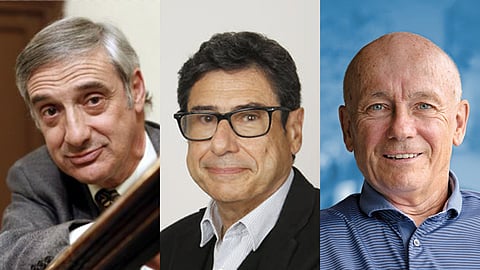
In today’s rapidly changing global economy, understanding the relationship between technology and development is more important than ever. A modern theoretical framework that helps illuminate this relationship is the notion of creative destruction — the idea that new technological innovations continuously replace old ones, thereby driving economic transformation and growth. This year’s 2025 Nobel Prize in Economic Sciences was awarded to Joel Mokyr, Philippe Aghion, and Peter Howitt precisely for their foundational work on how innovation fuels sustainable growth through creative destruction.
Technology and Development: Theoretical Foundations
Development is not merely about accumulating more machines or capital; at its core lies the ability to generate — and adopt — new ideas, processes, and institutions. Technology acts as a multiplier: it amplifies human effort, expands possibilities, and shifts constraints. Yet, technology does not always translate into development automatically. For technology to foster growth, three conditions are often needed:
1. Openness to Change and Institutional Support
Societies must allow old structures to be challenged, encourage experimentation, and maintain institutions that support innovation (legal frameworks, property rights, education, free exchange of ideas).
2. Continuous Innovation Cycles
One breakthrough leads to another. This cumulative process builds momentum, pushing productivity upward.
3. Managing Displacement
As new technologies replace old ones, some industries or firms decline. A society must manage these dislocations — through retraining, reallocation, social safety nets — to prevent backlash that impedes further innovation.
It is in this ecosystem of evolving ideas that development can become sustainable and dynamic.
Creative Destruction: From Schumpeter to the Nobel Laureates

The term “creative destruction” is often traced to Joseph Schumpeter, who used it to describe how new innovations disrupt existing economic structures. Building on that insight, Aghion and Howitt in 1992 formalized it with mathematical models in which firms invest in new technologies, overtaking incumbents. When a new product or process emerges, it displaces the old, but paves the way for higher productivity. rical and epistemic prerequisites for sustained growth. He argued that innovation must be