Bharat Newz 24*7
Kolkata, July 28, 2025:
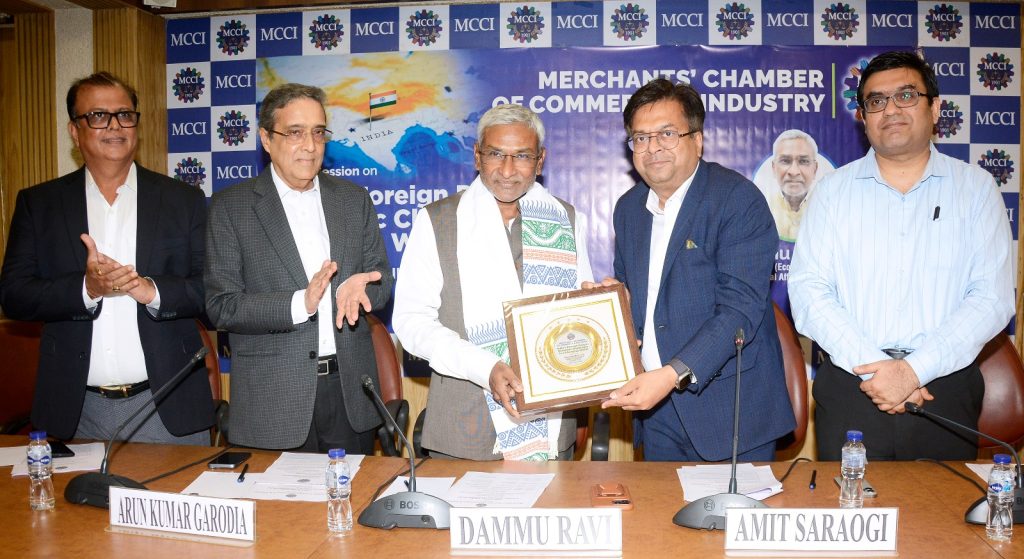
The Merchants’ Chamber of Commerce & Industry (MCCI) hosted a special session today on “India’s Foreign Policy: Economic Challenges in a Changing World”, featuring Shri Dammu Ravi, IFS, Secretary (Economic Relations), Ministry of External Affairs, Government of India. The event took place at the MCCI Conference Hall, drawing diplomats, business leaders, and policy experts into a dialogue on India’s economic diplomacy and global integration.
In his keynote address, Shri Dammu Ravi said that the vision of Atmanirbhar Bharat must align with the broader goal of ‘Make for the World’. Emphasizing the need to position India as a global manufacturing hub, he laid out a roadmap for achieving Viksit Bharat 2047, India’s vision of a fully developed economy.
Boosting Manufacturing and Reducing Logistics Costs
Shri Ravi pointed out that to achieve sustainable double-digit growth, India must scale up its manufacturing sector, supported by the development of industrial corridors, clusters, and export-oriented strategies. He noted that logistics costs in India remain at 12%, nearly 4% higher than other competitive economies. Reducing this burden through better infrastructure and policy reforms would be essential to make Indian products globally competitive.
He highlighted the need for state-level interventions and handholding for businesses, with special attention to West Bengal. “West Bengal is a crucial connection for BIMSTEC, linking India to the Indo-Pacific region,” he said, underlining the state’s strategic role in regional economic engagement.
Expanding Global Trade Footprint and Currency Strategy
The MEA Secretary also touched upon India’s growing role in the Global South, citing India’s contribution to automation in payments, including UPI and FinTech innovations, and the rise of tri-lateral cooperation models to boost international collaboration.
He clarified that India’s move to settle international trade in Indian Rupees is not an attempt at de-dollarization but a strategy to strengthen the Indian currency and reduce dependence on foreign exchange fluctuations.
—
Private Sector and Strategic Diplomacy
Earlier, Shri Amit Saraogi, President of MCCI, welcomed the gathering and emphasized on forging sustainable partnerships in technology, innovation, and start-ups to make India globally competitive. He recommended increasing investments in Africa, Southeast Asia, and the Indian Ocean Region for expanding market access and building goodwill.
Shri Arun Kumar Garodia, Chairman of MCCI’s Council on Foreign Trade, praised the government’s efforts in enhancing trade ties, especially citing the India-UK trade agreement as a landmark step. He also stressed the crucial role of the private sector in advancing India’s diplomatic and economic agenda.
Concluding the event, Shri Yogesh Gupta, Co-Chairman of the MCCI Council on Foreign Trade, extended the vote of thanks and appreciated the forward-looking vision of Make in India articulated by Shri Ravi.

The session reflected India’s evolving foreign policy focus on economic resilience, regional cooperation, and global leadership. With strategic policy shifts and stronger private-public collaboration, India aims to become a central pillar in shaping a new global economic order.