

Bharat Newz 24*7
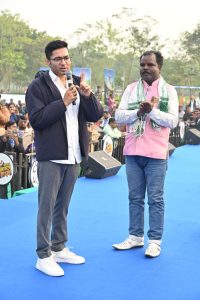
In an era where political rallies are often reduced to one-sided speeches delivered from towering stages, Trinamool Congress national general secretary Abhishek Banerjee attempted something radically different in Alipurduar. Instead of addressing a sea of people from a distance, he transformed a political meeting into a Janata Darbar—a public court where citizens spoke first, and the leader listened.
This approach, rare in Indian electoral politics, marked a significant departure from traditional political communication. Thousands gathered not just to hear Abhishek Banerjee, but to be heard by him. From tea garden workers to women beneficiaries of welfare schemes, people placed their problems directly before a senior political leader, many for the first time.
A Political Gathering Turned into a Public Hearing
Abhishek Banerjee made it clear from the outset that this was not meant to be a conventional rally. Instead of focusing solely on delivering a speech, he invited people to submit their questions and complaints in advance. Special forms were distributed well before the meeting began, asking attendees to write down their concerns along with their names and addresses.
After the public meeting, Abhishek personally responded to several of these questions from the stage. In doing so, the rally evolved into a functioning grievance redressal forum—something seldom witnessed at such a large political gathering.
This model, first introduced earlier in Baruipur, found a strong response in Alipurduar, particularly in the tea garden belt where long-standing issues related to wages, healthcare, housing, and social security remain unresolved.
Sharp Attack on BJP and the Central Government
Alongside public interaction, Abhishek Banerjee launched a strong political attack on the BJP-led central government and BJP representatives in North Bengal. He repeatedly drew comparisons between Trinamool Congress governance in West Bengal and BJP’s approach at both the state and central levels.
He pointed out that despite Alipurduar consistently electing BJP MPs and MLAs in the 2019, 2021, and 2024 elections, the West Bengal government never discriminated against the region.
“Did the state stop Lakshmir Bhandar payments because BJP won here? No. That is the difference between BJP and Trinamool,” Abhishek said, stressing that welfare schemes continued irrespective of electoral outcomes.
He also reminded the audience of promises he had made during his 2022 visit to Alipurduar, stating that while some projects had already begun, others were still in progress. According to him, development takes time, but the intent and effort remain consistent.
MGNREGA, Tea Workers, and Central Neglect
One of Abhishek Banerjee’s strongest criticisms was directed at the Centre for allegedly withholding funds under the 100-day work scheme (MGNREGA).
“For five years, the Centre has stopped Bengal’s dues because BJP lost elections here,” he alleged. “But even if Trinamool loses, the state government does not stop welfare projects.”
He also accused the central government of neglecting tea garden workers, particularly on issues such as EPF, minimum wages, healthcare facilities, and infrastructure. BJP MPs from the region were criticised for remaining inactive during crises, including the devastating floods of 2024.
“When floods hit, no BJP leader came. Mamata Banerjee came from Kolkata, stood beside the people, repaired roads and houses,” Abhishek said.
Concerns Over Electoral Processes and Polarisation
Touching upon electoral reforms, Abhishek Banerjee raised concerns over the SIR (Special Intensive Revision) process, alleging harassment of genuine voters.
“Living people are being declared dead. If that’s not magic, what is?” he remarked sarcastically, targeting the Election Commission leadership.
He also accused BJP of promoting divisive politics in the name of religion, asserting that democracy cannot survive if people are told what to eat, wear, or believe.
“My religion teaches humanity. The biggest religion is being human,” he said.
Healthcare and Welfare: Trinamool vs BJP
Rejecting BJP’s claims on healthcare, Abhishek asserted that while Ayushman Bharat does not cover everyone, West Bengal’s Swasthya Sathi scheme ensures universal coverage.
“This election is about teaching BJP a lesson,” he said, calling upon Alipurduar to play a leading role in making Mamata Banerjee the Chief Minister for a fourth term.
Voices from the Janata Darbar
The most impactful part of the event was the direct interaction with citizens.
Rita Terwar, whose husband works in Dubai, complained about being summoned repeatedly for voter verification. Abhishek assured her that her name could not be removed legally and guided her through the proper process.
Suresh Suri, a tea worker since 1995, spoke about the absence of housing and land rights. Abhishek acknowledged the sensitivity of land patta issues and promised intervention through labour organisations.
Jayprakash Khakha raised concerns about the lack of doctors, ambulances, and healthcare facilities in tea gardens. Abhishek admitted gaps in implementation and said he would personally follow up with the Chief Minister.
Rajesh Oraon, called on stage, detailed a 14-point list of demands, including wage hikes, school transport for children, and medical care. Abhishek openly admitted that ₹250 daily wages were insufficient and promised that if Trinamool returns to power, tea gardens would become a top priority. He committed to raising wages to ₹300 and announced immediate steps like starting school bus services and ensuring ambulances and crèches.
Sangeeta Oraon highlighted the lack of functional crèches, forcing women to bring children to unsafe work environments. Abhishek promised full operationalisation of crèches within months.
Parbat Mahato spoke about six months of unpaid wages. Abhishek said non-payment for completed work was unacceptable and assured administrative action.
Mila Nagasia, who had not received Rupashree scheme benefits, was asked to send her application details directly. Abhishek said arrangements would be made the same day.
A New Political Template
By the end of the event, it was evident that Abhishek Banerjee’s Alipurduar Janata Darbar was more than a political show. It was an attempt to redefine how leaders engage with citizens—less as spectators, more as participants.
Whether this model becomes a sustained political practice remains to be seen. But for many in Alipurduar’s tea gardens, this was the first time power felt accessible, responsive, and human.
And in today’s political climate, that itself is a powerful statement.