

Bharat Newz 24*7
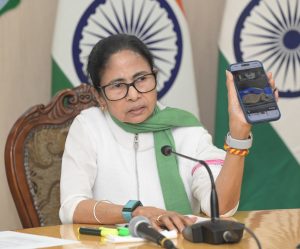
West Bengal Chief Minister Mamata Banerjee has reignited the political debate over state identity and federal fairness after the Union Cabinet approved the renaming of Kerala to “Keralam.” While congratulating the people of Kerala, she simultaneously launched a sharp attack on what she described as a “BJP-CPM understanding,” alleging that the Centre’s swift approval exposes a deeper political alignment between rivals in that state.
Her remarks came shortly after the Union government cleared the proposal of the Kerala Assembly to officially adopt the name “Keralam.” The state is currently governed by the Communist Party of India (Marxist)-led Left Democratic Front, while the Centre is led by the Bharatiya Janata Party under Prime Minister Narendra Modi.
“No Longer an Unwritten Alliance”
Banerjee’s sharpest comment was her suggestion that the approval of Kerala’s name change proves that what she calls a “Left–BJP nexus” is no longer unwritten. “After today,” she implied, “this understanding is no longer informal—it stands exposed.”
Her political argument is rooted in contrast. While Kerala’s proposal received central approval ahead of an election cycle, West Bengal’s long-pending demand to rename the state “Bangla” has remained stuck for nearly eight years.
She congratulated the people of Kerala, stating that she respects the democratic right of any state to assert its linguistic and cultural identity. But she quickly pivoted to the larger issue: why has West Bengal’s similar proposal not been cleared despite repeated Assembly resolutions?
The Long Journey of the ‘Bangla’ Proposal
The demand to rename West Bengal to “Bangla” is not new. In 2016, the West Bengal Legislative Assembly unanimously passed a resolution proposing a name change. The argument was simple: the colonial-era term “West Bengal” no longer reflected the cultural and linguistic identity of the state.
However, the Union Home Ministry reportedly advised the state to adopt a single name across all languages rather than three variations. Responding to that suggestion, the Assembly again passed a unanimous resolution in 2018, proposing that the state be known simply as “Bangla” in Bengali, Hindi and English alike.
Since then, the proposal has been pending with the Centre.
Banerjee made it clear that she had personally raised the issue multiple times with the Prime Minister and Union Home Minister, including during Eastern Zonal Council meetings. Yet, she said, there has been no movement.
The Alphabet Argument and Perceived Discrimination
In one of her more emotive arguments, Banerjee highlighted what she considers an overlooked but symbolic issue: alphabetical positioning. According to her, because the state is officially listed as “West Bengal,” it often appears at the end of official lists arranged alphabetically.
She argued that students from the state are sometimes called last in national-level interviews or examinations due to the alphabetical order. Even as Chief Minister, she claimed, she is often scheduled last at inter-state meetings.
While critics may dismiss this as symbolic, Banerjee framed it as a matter of dignity and perception. “Why should Bengal always be pushed to the end?” she asked, rhetorically questioning whether bureaucratic inertia masks deeper political bias.
Political Undertones: Federalism or Electoral Strategy?
From a political analyst’s perspective, Banerjee’s intervention serves multiple purposes.
First, it reasserts her long-standing pitch that the Centre discriminates against opposition-ruled states, particularly those governed by the All India Trinamool Congress. By juxtaposing Kerala’s swift approval with Bengal’s pending proposal, she seeks to frame the issue as selective federalism.
Second, it positions her as a defender of Bengali identity and pride. The argument that “Bangla” better reflects the state’s cultural heritage taps into linguistic and emotional sentiment—an effective strategy in a politically charged pre-election atmosphere.
Third, by alleging a tacit understanding between the BJP and the CPM in Kerala, she attempts to weaken both opponents simultaneously in West Bengal’s political discourse.
The Centre’s Silence
So far, there has been no official explanation from the Union government as to why the Bengal proposal remains pending. Administrative procedures for renaming a state require parliamentary approval after central clearance, but the absence of visible progress has fuelled political suspicion.
It is worth noting that several states across India have successfully changed names over the past decades following due process. Banerjee’s core question, therefore, resonates: if others can secure approval, why not Bengal?
Beyond the Rhetoric
While the Kerala renaming decision is primarily symbolic, the controversy surrounding Bengal’s pending proposal highlights deeper tensions in India’s federal structure. Identity politics, centre-state relations, and electoral strategy are intertwined.

For Banerjee, the issue is about respect and recognition. For her critics, it may be a tactical move to consolidate regional sentiment ahead of electoral battles.
What is undeniable is this: the debate over names has once again become a proxy for a larger political struggle. As the 2026 Assembly election approaches, issues of identity, dignity and federal fairness are likely to feature prominently in West Bengal’s political narrative.
Whether “Bangla” eventually becomes official remains uncertain. But politically, the name has already become a rallying cry.