Bharat Newz 24*7
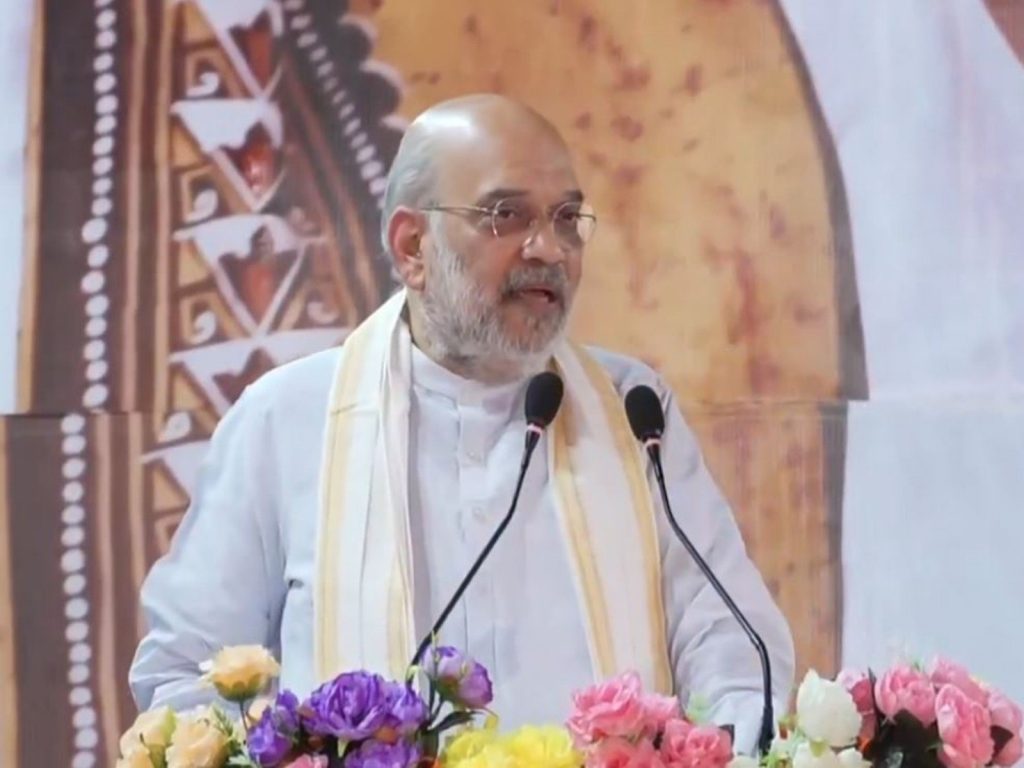
Union Home Minister Amit Shah has set the tone for the BJP’s next political battle in West Bengal with a blistering speech that squarely targets Chief Minister Mamata Banerjee and her inner circle. Addressing a rally in Mathurapur in South 24 Parganas, Shah accused the Trinamool Congress (TMC) of turning governance into a family enterprise and warned voters against what he called the looming threat of “nephew rule.”
“If you bring Trinamool back to power, the nephew will become the ruler. Do you want nephew rule? Under the nephew’s leadership, corruption is flourishing in West Bengal,” Shah told a cheering crowd, directly alluding to Abhishek Banerjee, Mamata Banerjee’s nephew and the party’s national general secretary.
The speech marked the launch phase of the BJP’s ‘Parivartan Yatra’ in the state — a politically symbolic mobilisation that the party hopes will galvanise anti-incumbency sentiment across Bengal’s 294 Assembly constituencies. Shah formally kicked off the programme from Raidighi, accompanied by state BJP president Sukanta Majumdar, signalling the central leadership’s direct involvement in the state campaign.
Dynasty Politics as the Core Narrative
At the heart of Shah’s address was a carefully crafted narrative: that the TMC has drifted from grassroots politics to dynastic consolidation. “If you make the mistake of voting for Trinamool again, it won’t be ‘Didi’s rule’ — it will be the nephew’s rule. The Chief Minister is concerned only about her nephew’s growth, not the future of Bengal’s youth,” he said.
This line of attack is not new, but the intensity has sharpened. By repeatedly invoking the idea of a “nephew takeover,” Shah sought to transform what is often whispered in political circles into a full-blown campaign slogan. The BJP believes this framing could resonate with sections of voters uneasy about concentrated power within the ruling party.
Shah went further, claiming, “The BJP is the only party in the country that does not practise dynasty politics.” It was a sweeping assertion meant to contrast the BJP’s leadership model with regional parties often criticised for familial succession.
Social Media Offensive Before Ground Rally
Before arriving in Bengal, Shah took to social media with a strongly worded message in Bengali, accusing the TMC of misgovernance and asserting that the people of Bengal are yearning for change.
“The people of Bengal, devastated by Trinamool Congress misrule, now want change. To strengthen this public resolve, the BJP in Bengal has begun the ‘Parivartan Yatra’. Through this yatra, BJP workers will carry the pledge of an infiltration-free Bengal to every corner of the state,” he wrote.
The phrase “infiltration-free Bengal” once again underscored the BJP’s emphasis on illegal immigration — an issue the party has consistently foregrounded in the state’s polarised political climate.
Budget Allocation Sparks Fresh Controversy
Shah did not limit himself to questions of dynasty. He launched a pointed critique of the state’s recent budget allocations, questioning what he described as skewed priorities.
“The Mamata government has allocated only Rs 80 crore for science and technology, but Rs 5,700 crore for madrasas. Is the state’s agenda scientific advancement or appeasement?” he asked.
The remark drew sharp reactions and is likely to trigger a political counterattack from the TMC. For the BJP, however, this line reinforces its broader argument that the ruling dispensation is driven by vote-bank considerations rather than development metrics.
Seventh Pay Commission Promise
Seeking to balance criticism with promises, Shah assured state government employees that if the BJP comes to power in Bengal, the Seventh Pay Commission would be implemented.
This pledge is significant. Government employees and their families form a substantial voting bloc, and dissatisfaction over pay revision has simmered for years. By making a clear financial commitment, Shah aimed to tap into that sentiment.
Attack on TMC Leadership and Controversial Remarks
Shah also targeted TMC MLA Humayun Kabir, alleging that leaders with controversial backgrounds are being rewarded with party tickets. “Humayun and Mamata are two sides of the same coin. Those who have been to jail are being given tickets again,” he said.
In one of the most contentious moments of the rally, Shah added, “Another Babri Masjid is being built in your Bengal. Should this be happening? There is a conspiracy to bring Humayun Kabir out and construct a Babri Masjid.”
The reference to the Babri Masjid — a deeply sensitive subject in Indian politics — is certain to inflame debate. It signals the BJP’s willingness to invoke historical flashpoints to consolidate its core base.
Voter List Anxiety and Refugee Assurance
The rally also unfolded against the backdrop of anxiety over the recently published final voter list, from which nearly 6.3 million names have reportedly been deleted. Concerns have surfaced, particularly among sections of the Matua community, many of whom trace their roots to refugee backgrounds.
Addressing those fears, Shah offered a direct assurance: “The BJP government is in power at the Centre. Not a single Hindu refugee will lose citizenship.”
The statement was calibrated to reassure refugee communities who have long been politically influential in parts of southern Bengal.
The Road Ahead: More Than Just Changing a Chief Minister
Explaining the purpose of the Parivartan Yatra, Shah said, “This yatra is not merely about changing a Chief Minister. The people of Bengal will bring change themselves. Change means creating an infiltration-free Bengal.”
That distinction is crucial. The BJP wants to frame the contest not just as a personality clash with Mamata Banerjee but as a broader ideological shift — from what it calls corruption and appeasement to governance and national integration.

Whether this aggressive pitch will translate into electoral gains remains to be seen. Bengal’s electorate has historically resisted outside pressure, yet it has also shown an appetite for dramatic political shifts, as evidenced in past decades.
What is clear is that the battle lines are now sharply drawn. With the Parivartan Yatra covering all 294 constituencies and central leaders expected to make frequent appearances, Bengal is heading into another intense and deeply polarised political season — one where every speech, every slogan, and every allegation could shape the state’s next chapter.