Bharat Newz 24*7
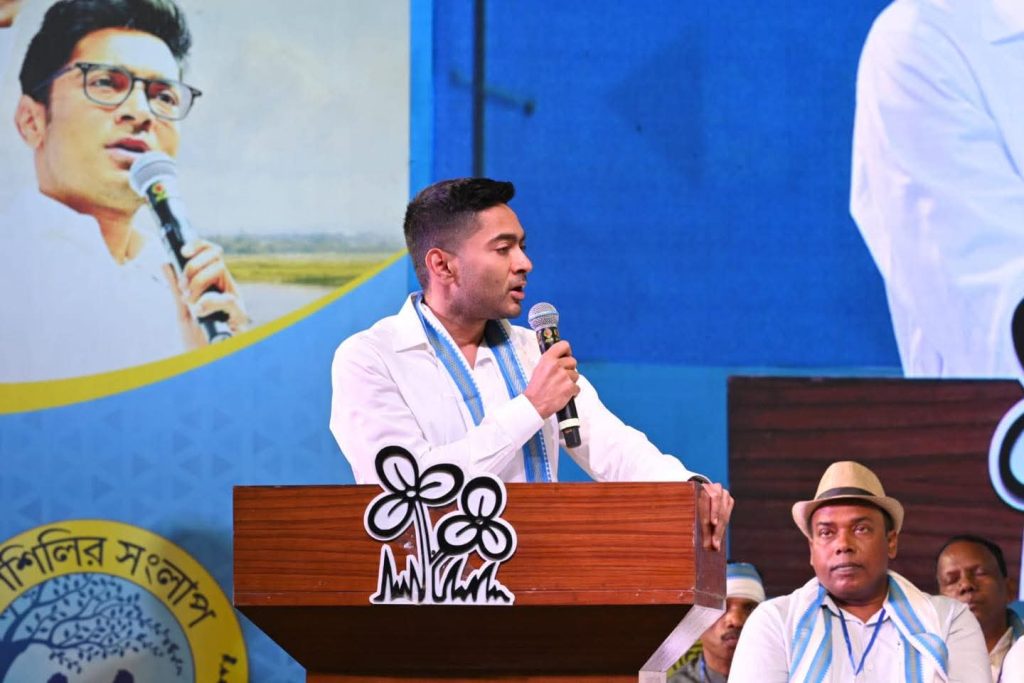
Trinamool Congress national general secretary Abhishek Banerjee has added a fresh dose of satire and aggression to Bengal’s fast-heating political climate. At a high-level organisational meeting at Nazrul Mancha in Kolkata, Abhishek took a swipe at the BJP’s ongoing ‘Parivartan Yatra’, mockingly urging party workers to greet the saffron camp’s Rath Yatra with traditional Bengali hospitality — fish, meat and eggs included.
“When BJP leaders come to your area with their chariots, cook fish and meat for them,” he told party workers. Then, explaining the provocation behind the remark, he said, “The Deputy Chief Minister of Bihar is saying people should not eat fish or meat. When they pass through your area in the name of Parivartan Yatra, stand there with fish, meat and eggs cooked. If they don’t want to eat, that’s their choice. But our culture teaches us ‘Guest is God’. When someone comes from outside, we welcome them.”
The comment instantly reframed the BJP’s religiously infused Rath Yatra into a cultural debate rooted in Bengal’s food habits and identity politics. Abhishek added with characteristic flourish, “Tell them — you’ve withheld our funds for years. At least have this meal. Serve them sweets, tea, everything. And tell them to keep their chariots safe, because they’ll need those same chariots to leave.”
Satire Meets Strategy
The sarcasm did not end there. Taking aim at the timing and scale of the BJP’s chariot campaign, Abhishek said, “I had never heard of Rath Yatra in the month of Phalgun. I’ve heard of Lord Jagannath’s Rath Yatra. I’ve heard of Krishna and Arjuna’s chariot in the Mahabharata. But now I see these second-grade leaders riding chariots.”
Referring to the BJP’s strength in the Assembly, he quipped, “With 70 MLAs they are riding chariots. If they had crossed 200 seats, would they have built four-storey chariots? Their feet are no longer touching the ground. They may stay on chariots, but Trinamool will stay on the streets. And from those very chariots, their farewell bell will ring.”
Behind the humour, however, lay a serious electoral blueprint.
The 2026–2029 Roadmap
The Nazrul Mancha meeting was not merely rhetorical theatre. It marked the launch of “Tapasili Sanglap”, an outreach programme targeting Scheduled Caste and Scheduled Tribe communities — a demographic both the TMC and BJP view as electorally decisive.
Abhishek framed the 2026 Assembly election as the foundation stone for a larger national contest. “If you bring the BJP below 50 seats in 2026, their government in Delhi will not survive till 2029,” he declared, raising the stakes far beyond Bengal.
He set an ambitious organisational target: increase victory margins from 40,000 votes to 50,000 per constituency. “For the next two months, there is no option but the field. Go door to door. Speak to every family,” he urged party workers. “Make Mamata Banerjee win in more than 250 seats. We must reduce them to zero.”
Chief Minister Mamata Banerjee remains the central figure in TMC’s campaign calculus, and Abhishek’s speech was as much about consolidating her fourth-term bid as it was about countering the BJP.
Voter List Controversy
Abhishek also seized upon the controversy surrounding the recently revised voter list, from which over six million names have reportedly been deleted, with another large chunk marked “under adjudication.”
Raising a pointed question, he said, “If the ordinary citizens who elected the Prime Minister and the Home Minister are now under adjudication, why shouldn’t the Prime Minister also be under adjudication?”
The line was crafted to resonate with voters anxious about their status, especially in refugee-dominated belts where fears of disenfranchisement have resurfaced.
Constitution and Reservation Concerns
Turning ideological, Abhishek accused the BJP of harbouring designs to dilute constitutional safeguards. “With 240 MPs, they want to change the Constitution written by B.R. Ambedkar. If they return to power, the reservation rights given to SC and ST communities will be taken away,” he alleged.
Invoking B. R. Ambedkar, he accused the BJP of paying lip service to the architect of the Constitution while undermining his legacy. “The Home Minister says taking Ambedkar’s name has become a fashion. Why does it hurt him?” Abhishek asked.
He also criticised the proposed Uniform Civil Code and warned against what he termed “Delhi landlords” dictating what Bengalis can eat. “They will not decide who in Bengal sells chicken patties or egg chowmein. As long as we are here, we will not allow that.”
NCRB Data and SC-ST Outreach
Citing data from the National Crime Records Bureau, Abhishek claimed that atrocities against SC and ST communities are highest in BJP-ruled states. “They talk of double-engine government. Go to the northern districts where their MPs and MLAs are elected and see how much money they’ve brought from the Centre. Five years have passed, not even a 10-paisa bulb has been lit,” he said.

The political messaging is clear: combine cultural identity, constitutional safeguards, and economic grievance into a single narrative that pits Bengal’s regional assertion against what the TMC describes as external imposition.
With both the BJP and TMC escalating rhetoric through yatras and counter-campaigns, Bengal’s 2026 battle has effectively begun. And if Abhishek Banerjee’s speech is any indication, it will be fought not just on policy, but on symbolism, identity and the everyday rhythms of Bengali life — right down to what’s cooking in the kitchen.