Bharat Newz 24*7
For months, the fear was spreading quietly across villages, towns and urban neighbourhoods — if a person’s name disappeared from the voter list during the Special Intensive Revision (SIR) process, would they also lose their citizenship status?
On Wednesday, the Supreme Court delivered a verdict that may significantly reshape that debate ahead of crucial elections in West Bengal and other politically sensitive states.
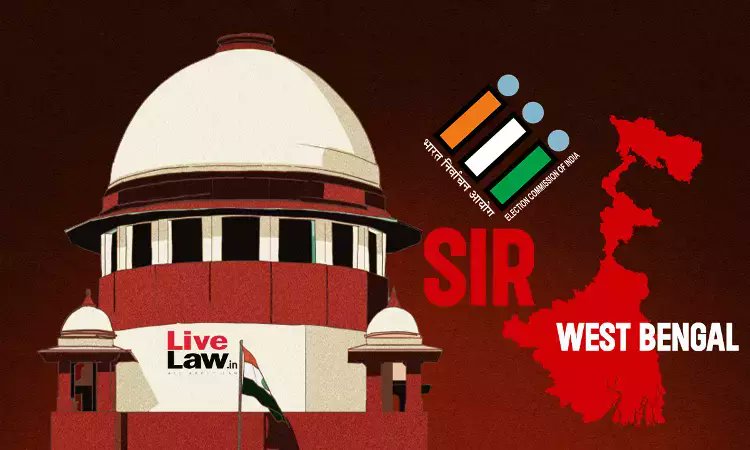
In a landmark ruling, the apex court upheld the constitutional validity of the Election Commission’s Special Intensive Revision process. At the same time, however, the court made one thing absolutely clear: removal from the voter list does not automatically mean loss of Indian citizenship.
The judgment has instantly altered the political narrative around SIR, particularly in Bengal, where opposition parties and civil rights groups had repeatedly accused the Centre and the Election Commission of using voter verification as an indirect citizenship filter.
The ruling came from a bench led by Chief Justice Suryakant and Justice Joymalya Bagchi after months of intense legal arguments over the Election Commission’s authority to conduct large-scale voter verification exercises.
The court observed that under Article 324 of the Constitution, along with provisions of the Representation of the People Act, 1950, the Election Commission possesses the authority to carry out Special Intensive Revision exercises to maintain clean and updated electoral rolls.
In simple terms, the court said the Commission has every right to decide who qualifies to remain on the voter list and what documents are necessary for verification.
But the judges also drew a sharp constitutional boundary.
The Election Commission, the court said, cannot decide who is or is not an Indian citizen. That authority rests solely with the Central Government and the ministries empowered under citizenship laws.
The distinction may sound technical, but politically it is explosive.
For nearly a year, the SIR exercise had triggered anxiety across several states, especially Bihar and West Bengal. Thousands feared that deletion from electoral rolls could eventually brand them as “illegal immigrants” or “non-citizens.”
That fear was repeatedly amplified in Bengal’s intensely polarised political environment, where citizenship issues, border infiltration and identity politics remain emotionally charged electoral themes.
The controversy first escalated during the Bihar Assembly election preparations last year, when the Election Commission initiated an extensive SIR process. Initially, voters were reportedly required to produce as many as 11 supporting documents. Following judicial intervention, Aadhaar was later included among acceptable documents.
Soon after, similar voter verification exercises began drawing attention in West Bengal ahead of the Assembly elections.
Multiple petitions were filed before the Supreme Court by activists, opposition parties and civil society groups challenging both the legality and intent of the exercise. Petitioners questioned whether the Election Commission was overstepping its constitutional role by indirectly entering the domain of citizenship determination.
During the hearings, lawyers representing the Election Commission argued that only Indian citizens can be voters. Therefore, verifying citizenship status while revising electoral rolls was both logical and legally necessary.
Petitioners countered that citizenship determination falls under entirely separate legal and administrative mechanisms controlled by the Union government, particularly the Home Ministry.
On Wednesday, the Supreme Court attempted to strike a constitutional balance between these competing arguments.
The court ruled that while the Election Commission can demand documents and verify eligibility for inclusion in electoral rolls, it cannot treat exclusion from the voter list as a final declaration of non-citizenship.
The judgment further directed that cases involving suspected citizenship disputes must be forwarded to the appropriate ministries of the Central Government within four weeks.
Crucially, the court also warned against indefinite bureaucratic delays.
The Centre, the judges observed, cannot keep such cases pending endlessly while individuals remain trapped in uncertainty. Citizenship-related decisions concerning those removed from electoral rolls must be completed before the next Lok Sabha elections or the next Assembly elections in the concerned states.
That observation carries massive implications.
Because in states like West Bengal, being excluded from electoral rolls is not merely about voting rights. It can influence access to welfare schemes, social benefits, government support systems and even broader questions of identity and belonging.
The ruling immediately triggered sharp political reactions.
Trinamool Congress MP and senior lawyer Kalyan Banerjee claimed the verdict had effectively demolished the narrative that deletion from voter rolls automatically proves someone is an infiltrator.
“The Supreme Court has clearly rejected the argument that people whose names are deleted from the voter list automatically become non-citizens,” Banerjee said after the judgment.
Political observers believe the verdict creates a complicated situation for both the Centre and opposition parties.
On one hand, the ruling strengthens the Election Commission’s institutional authority and validates the legality of SIR exercises. On the other, it places the final burden of citizenship determination squarely on the Union government.
That shift matters politically.
In Bengal, where the BJP has repeatedly focused on issues like infiltration, border security and citizenship verification, the verdict could reshape campaign messaging ahead of the 2026 Assembly elections.
For the Trinamool Congress, meanwhile, the judgment offers political ammunition to counter allegations surrounding “outsider” narratives and fears linked to voter deletion drives.
But beyond electoral calculations, the larger concern remains deeply human.
Across districts in Bengal, especially border regions, uncertainty over documentation has long created silent anxiety among economically vulnerable families. Many lack updated records despite living in India for generations. For them, voter list verification is not simply an administrative exercise — it is tied to dignity, identity and survival.
That is precisely why Wednesday’s verdict may prove to be one of the most politically consequential constitutional rulings before the next major election cycle.
The Supreme Court has allowed the Election Commission to clean electoral rolls. But it has also reminded the state that citizenship cannot be casually questioned through administrative shortcuts.
And now, as Bengal inches closer to another fiercely contested election season, one uncomfortable question hangs heavily in the air — will this verdict calm public fears, or ignite an even bigger political battle over identity and citizenship?