Bharat Newz 24*7
A dramatic showdown inside Bengal’s principal opposition party has exposed deep cracks in its leadership structure, with Ritabrata Banerjee securing overwhelming support from lawmakers despite being expelled from the party.
Kolkata witnessed one of the most dramatic political developments in recent years on Wednesday as a fierce internal battle within the Trinamool Congress (TMC) spilled into the open. What began as a dispute over the appointment of the Leader of the Opposition has now evolved into a full-fledged power struggle, raising serious questions about the future direction of the party founded by Mamata Banerjee.
In a stunning turn of events, expelled TMC leader Ritabrata Banerjee was officially recognized as the Leader of the Opposition in the West Bengal Assembly after submitting letters of support from 58 elected TMC legislators. The development came despite the party leadership’s attempt to install veteran MLA Shovandeb Chattopadhyay in the post.
The episode has laid bare the extent of internal dissent within the party and has sparked intense speculation about a growing divide between different power centres inside the organization.
The Battle for the Opposition Leader’s Post
The controversy began after the TMC leadership formally proposed Shovandeb Chattopadhyay’s name for the position of Leader of the Opposition. Letters supporting his candidature were submitted to Assembly Speaker Rathindra Bose on multiple occasions.
However, the Speaker reportedly raised procedural and technical objections regarding the documents submitted. This created an opening for Ritabrata Banerjee and his supporters to make their move.
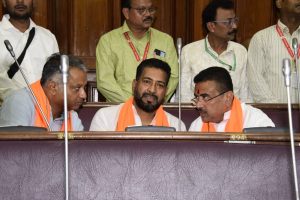
Armed with letters signed by 58 of the 80 MLAs elected on the TMC ticket in the recent Assembly election, Ritabrata approached the Speaker and staked his claim to lead the party’s legislative wing.
After verifying both the documents and the supporting legislators, the Speaker formally recognized Ritabrata Banerjee as the Leader of the Opposition, effectively overturning the leadership’s preferred choice.
Political observers believe the decision represents far more than a procedural victory. It is being viewed as a direct challenge to the authority of the party’s current organizational leadership.
Ritabrata Claims Numbers Are Still Growing
Speaking after receiving official recognition, Ritabrata projected confidence and suggested that his support base could become even stronger.
“We currently have the support of 58 legislators. Two more members are outside the state at the moment and have already conveyed their support. Once they formally join us, the number will rise to 60,” he said.
His remarks immediately triggered fresh political chatter, with many questioning whether additional lawmakers could eventually switch sides within the party’s legislative structure.
Loyalty to Mamata, Not to the Current Leadership
Perhaps the most politically significant aspect of Ritabrata’s statement was his attempt to separate Mamata Banerjee’s leadership from the ongoing conflict.
Despite being expelled from the party only days ago, Ritabrata repeatedly emphasized his loyalty to the former Chief Minister and party founder.
“Mamata Banerjee remains our leader. We want her to serve as the chief adviser of our legislative group. Nobody can replace her. She is the final authority and the guiding force of the movement she built,” he said.
The message appeared carefully crafted to reassure grassroots workers and supporters who continue to identify strongly with Mamata Banerjee’s leadership while expressing dissatisfaction with the current power structure.
Sharp Attack on Abhishek Banerjee
Ritabrata also launched a pointed attack on TMC National General Secretary Abhishek Banerjee, who has increasingly become one of the most influential figures in the party.
Questioning Abhishek’s role in Assembly affairs, Ritabrata argued that the MP has no constitutional position within the state legislature.
“Abhishek Banerjee is a Member of Parliament, not a member of the Assembly. The Speaker alone has the authority to examine the documents submitted to the House. If any forgery is established, appropriate legal and constitutional action can follow,” he said.
The comments are likely to intensify tensions between the two camps and could mark the beginning of a prolonged political confrontation inside the opposition ranks.
New Legislative Team Announced
In another indication that he intends to function as the undisputed head of the legislative bloc, Ritabrata announced a new parliamentary structure.
According to him, Akhruzzaman, MLA from Raghunathganj, will serve as the Chief Whip.
Former ministers Javed Khan, Sabina Yasmin and Shiuli Saha, along with Sandipan Saha, have been designated as Deputy Leaders.
The announcement signaled that Ritabrata’s group is not merely challenging an appointment but is attempting to establish an alternative leadership framework within the Assembly.
Senior Leaders Join the Camp
The list of legislators backing Ritabrata includes several experienced and influential political figures from different regions of West Bengal.
Among those reportedly supporting him are Arup Roy from Howrah Central, Tapas Maity from Domjur, Subhashis Das from Maheshtala, Barnali Dhara from Kulpi, Shiuli Saha from Keshpur, Noor Alam from Samserganj, Niyamat Sheikh from Hariharpara, Abdul Aziz from Lalgola, Akhruzzaman from Raghunathganj, Sabina Yasmin from Sujapur, Sandipan Saha from Entally, Chandranath Sinha from Bolpur and former minister Javed Khan.
The breadth of support has surprised many political analysts, particularly because it cuts across districts and factions that have historically operated independently.
A Defining Moment for Bengal Politics
The recognition of Ritabrata Banerjee as Leader of the Opposition could prove to be a watershed moment in West Bengal politics.
For years, internal disagreements within the TMC were largely managed behind closed doors. This time, however, the conflict has unfolded in full public view, exposing competing centres of authority and contrasting visions for the party’s future.
The coming weeks will reveal whether the current alignment of legislators remains intact or whether efforts will be made to reunify the ranks. What is already clear is that the political landscape has shifted dramatically.
The biggest question now is simple but consequential: can the party leadership regain control of its legislative wing, or has a new power equation already begun to take shape inside Bengal’s opposition camp? The answer may determine the future course of state politics.