
Bharat Newz 24*7
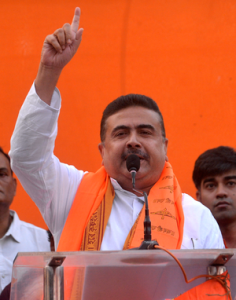
West Bengal Chief Minister Suvendu Adhikari on Tuesday unveiled a series of major welfare and infrastructure initiatives for the Jangalmahal region, announcing a ₹1,200 crore allocation for development, enhanced financial support for tribal students, higher assistance under the Joy Johar scheme, and a tough warning against the alleged misuse of fake Scheduled Caste (SC) and Scheduled Tribe (ST) certificates.
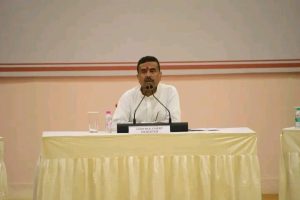
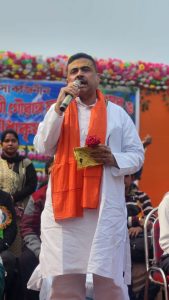
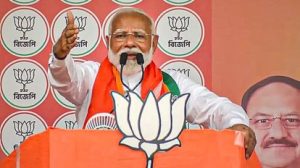
Addressing a large gathering at Mukutmanipur in Bankura on the occasion of Hul Diwas, the Chief Minister said his government was committed to transforming one of the state’s most historically underdeveloped regions through targeted investment in infrastructure, healthcare, education and tribal welfare.
Highlighting the scale of the government’s plans, Adhikari said the allocation for Jangalmahal had increased dramatically compared to the previous financial year.
“You will be surprised to know that only around ₹6 crore worth of work was carried out across 75 blocks of Jangalmahal during the 2025-26 financial year. This year, we have earmarked ₹1,200 crore in the budget. Large-scale development will take place across these blocks. We will strengthen healthcare facilities, ensure drinking water reaches villages and build community halls,” he said.
Jangalmahal, comprising Bankura, Purulia, Jhargram and parts of Paschim Medinipur, has long remained a politically and economically significant region. Successive governments have announced development packages for the area, but the BJP government is now positioning this latest investment as one of its biggest interventions aimed at accelerating growth and improving the quality of life for tribal communities.
The Chief Minister also announced a substantial increase in financial support for tribal students residing in government hostels. Monthly hostel assistance has been raised from ₹1,800 to ₹3,300, a move that the government believes will reduce the financial burden on students pursuing education away from home.
Another significant announcement concerned beneficiaries of the Joy Johar scheme, under which elderly tribal women receive financial assistance from the state. Adhikari declared that the monthly benefit would be increased by ₹500, taking the total monthly assistance to ₹1,500.
Speaking on the significance of Hul Diwas, which commemorates the historic Santhal uprising against British rule, the Chief Minister stressed the importance of protecting the rights, identity and dignity of tribal communities.
“For the first time, a BJP government has had the opportunity to officially celebrate Hul Diwas. The struggle for land, water and rights must continue to receive the recognition it deserves. Earlier governments did not give you the respect you deserved. It was Atal Bihari Vajpayee who recognised your identity. We want you to stand beside us as equal partners in building a developed India,” Adhikari said.
He also highlighted the representation of tribal leaders within his government, saying several tribal ministers had been included in the Cabinet to ensure that policymaking reflected the aspirations of indigenous communities.
Looking ahead, the Chief Minister said the government would continue to focus on agriculture, horticulture, education and overall development across western West Bengal. He claimed that several Central government schemes had already been implemented in the state and that people would begin receiving their benefits from August.
“We are examining how agriculture and horticulture can be expanded further. Development work will continue across the Jangalmahal region, ensuring long-term economic growth,” he said.
The Chief Minister also launched a sharp attack over the alleged issuance of fake caste certificates during previous administrations. Referring to the debate on the OBC Amendment Bill in the West Bengal Assembly, Adhikari accused earlier governments of allowing widespread irregularities in the distribution of SC and ST certificates.
“Previous governments denied genuine tribal communities their rightful reservations while thousands of fake SC and ST certificates were issued. Investigations are underway. If anyone is found guilty, both the official who issued the certificate and the individual who obtained it fraudulently will be sent to jail. We will not allow fake certificates to deprive tribal communities of their rights,” he said.
His remarks signal that the issue of alleged fake caste certificates is likely to remain a major political issue in the state in the coming months, particularly with investigations continuing into alleged irregularities.
The Chief Minister also outlined an ambitious roadmap to improve connectivity, healthcare and tourism in the region. He proposed better road links connecting the industrial cities of Jamshedpur in Jharkhand and Durgapur in West Bengal through Purulia and Bankura, describing the project as part of a broader strategy to unlock economic opportunities in western districts.
“Our vision is to connect two major industrial hubs through nearly 200 kilometres of improved roads. Purulia and Bankura will emerge as major centres of development,” he said.
Healthcare infrastructure also featured prominently in the government’s plans. Adhikari announced that a new hospital would be established at Mukutmanipur with financial assistance from the Paschimanchal Unnayan Department.
Tourism, he added, would become another pillar of regional development. Calling Mukutmanipur an “ideal tourist destination,” he acknowledged that significant infrastructure gaps remained and assured that the Tourism Department, Tribal Welfare Department and Paschimanchal Unnayan Department would work together to modernise the area.
“There are several shortcomings in infrastructure here. We will address those issues and develop Mukutmanipur into a model tourist destination,” he said.
The Chief Minister also highlighted the government’s Annapurna Bhandar welfare programme, introduced after replacing the previous administration’s Lakshmir Bhandar scheme. According to Adhikari, nearly 1.51 crore women had applied under the scheme, while more than 1.20 crore applications had been verified and approved.
He announced that eligible beneficiaries would receive ₹3,000 directly into their bank accounts from July 1.

The announcements made during the Hul Diwas programme underline the government’s attempt to strengthen its political and developmental outreach in Jangalmahal, a region that has historically played a decisive role in West Bengal politics. With enhanced welfare measures, major infrastructure commitments and strong political messaging on tribal rights and alleged caste certificate irregularities, the state government has sought to position tribal welfare and regional development at the centre of its governance agenda.